

Tonight, I am Barney Panofsky, and This is Ziggy's Pub
Creative Nonfiction - Essay
by Vicki Donkin
Originally published in print in the Dark Anthology, Summer 2020
Tonight, I am Barney Panofsky. Not the real one, of course—that foul-mouthed, Habs-loving curmudgeon from Mordecai Richler’s Barney’s Version. But for an evening, I don’t mind slipping into his scuffed leather shoes and being a 67-year-old, washed-up TV producer and a nonpracticing Jew. I ditch my friends and head toward Dink’s, which is fictional, but in my Montreal, it’s a spiritual cocktail of Sir Winston Churchill’s and Ziggy’s Pub. I’m going to watch the Habs play the Bruins and sip a Scotch I can’t afford. That is what Barney would do. Going to the bar was the natural progression of the day for Barney, and so I, as him, will not fight fate and seat myself at Dink’s horseshoe-shaped bar to enjoy several glasses of Scotch and a win for the beloved Habs.
It’s early when I hit the metro, around 8:00 p.m., but I don’t want to miss the game. The metro is quiet, the downtown streets are still, and when I walk into Sir Winston Churchill’s, the place isn’t busy yet, but it smells like fried food.
I walk down a couple of stairs and situate myself at the bar—it’s shaped more like a bent paperclip than a horseshoe. It’s one of those Crescent Street institutions that is both proud and slightly past its prime. All the hardwood, stone tabletops, and dim lighting make this dirty basement feel like a Legion hall trying very hard to be a steakhouse. Still, I order a double Macallan, neat. That’s what Barney would do. The bartender, in all black, doesn’t bother hiding her eye roll. She brings the bill with my glass, and I instantly wish she could funnel it back into the bottle. Washed up? Barney must have had deeper pockets than I ever gave him credit for. The man could fund a distillery.
The Scotch itself is disappointing—too dry, too proud of its peat. I take another sip to analyze the flavour and find this Scotch to be a trickster. It hits my tongue sweet like honey, then turns bitter, like an ex who still texts late at night. Barney may have guzzled this stuff, but he must have had a more forgiving palate. Or fewer taste buds.
I settle in and look up at the TV screen—the score reads 0–1 for Boston. It dawns on me that I don’t know much about hockey, and that perhaps I should have researched the sport. Although with his son constantly correcting him, it doesn’t seem like Barney knew much about hockey either, so I’m sure I can manage.
Two older men are drinking red wine to my left, and I ask them if I missed anything. The one with more hair kind of grunts and turns back to his friend. So I try in French. This pisses him off, and he says, “On va jamais gagner, oublie ça.” These are clearly Dink’s sour old farts, and I haven’t drunk enough to argue with them.
Boston scores again. I launch the Scotch down my throat and leave some cash on the bar. This bar is fine. But it’s not Dink’s. It’s not right. I head out.
Crescent Street is still quiet. It’s –15°C outside, so the Macallan heat in my chest gives me the courage to scour the Crescent Street watering holes for Ziggy’s. My breath curls in the cold as I spot the modest sign for Ziggy’s glowing beneath a Jameson logo across the street. A group of guys are smoking on the sidewalk without their coats. I slide past them and down the steps, into a different world.
“My Girl” by The Temptations is playing from the TouchTunes jukebox. The bar is dim and windowless, warm with conversation. There it is: a perfect horseshoe-shaped bar. There are plaid-printed booths, dark hardwood, preemptive St. Patrick’s Day banners, and tons and tons of sports memorabilia—some baseball, but mostly hockey. This is no poser pub. This is a shrine.
Boston scores another goal, and a few people groan and cuss. I slide up to the bar and get a double Macallan—on ice this time. When the bartender pulls the bottle off the shelf, an older man a couple of stools down, with a receding hairline and a well-travelled smile, asks who ordered the Scotch. She nods in my direction.
“Are you doing a project on Mordecai Richler? Just had another one of you in a few days ago,” he says.
I tell him I don’t care about Mordecai Richler—that I’m more interested in a guy named Barney Panofsky. He’s never heard of any Panofsky, but he tells me about Richler anyway.
He tells me that Richler wasn’t a bad guy, just reserved and a little impatient. He had a close-knit circle of friends with whom he liked to drink and talk politics in the booth closest to the door. Eager students asking the same old questions about his writing used to annoy him, but when he got his cancer, he became easygoing and gracious. He would sit on the terrace and talk to a student for hours.
“It was like he was trading his wisdom for a little taste of their youth,” he explains.
“Hey, Ziggy!” A couple of middle-aged guys weave through the crowd to the back room, clapping the man’s back as they pass. Ziggy—like Ziggy of Ziggy’s. Not a mascot. Not a myth. A real man, with a lazy smile and a sense of humour that holds court.
“Twenty-three years in business,” he tells me. He points behind the bar to a bright red snapback hat with the slogan Make Ziggy’s Great Again written across the front. He laughs.
“It was fine before, but now it’s gonna be great.” The hats are so popular (especially with American tourists), he had to put in another order.
This prestigious little pub is overwhelming to the eye. The walls are completely covered in signed photos and plaques, and every shelf and ledge has trophies and memorabilia on it. The hallway to the bathroom is lined with photos of Ziggy and various sports icons and celebrities. It seems like he knows everyone.
Ziggy leans across the bar and tells me how much Richler loved this place, “Came here often. Brought his wife, Florence—she liked the champagne.” Ziggy stocked the half-bottles just for her.
He repeats it twice: He never cheated on her. He wants that part of the myth made clear.
Someone yells at the game. The Habs are getting steamrolled. Ziggy slaps the bar.
I yell, “That’s bullshit!” Ziggy laughs and tells the barmaid to pour me another Scotch, on the house. Okay, that never happened, but my bank account wishes it did.
Ziggy can’t take this game anymore, and as he gets up to leave, I ask him if Richler liked hockey. Of course, he did—but to my surprise, he loved NASCAR more. He loved it so much that Ziggy would open the bar at 8:00 a.m. just so he could watch the races.
“Hope you find that guy you’re asking about,” Ziggy says.
I smile. I won’t. Writers like Richler smuggled themselves into their characters. You find them in the places they loved—and in the people who remember them, behind a well-worn bar, pouring stories like drinks. Barney Panofsky isn’t real. Dink’s isn’t real. But Ziggy Eichenbaum is.
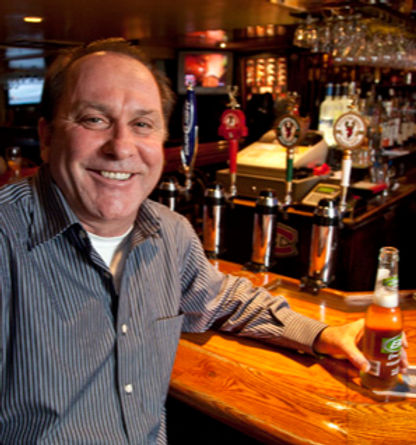
Pictured: Ziggy, at the bar, photo credit to Red Deer Advocate, 2016